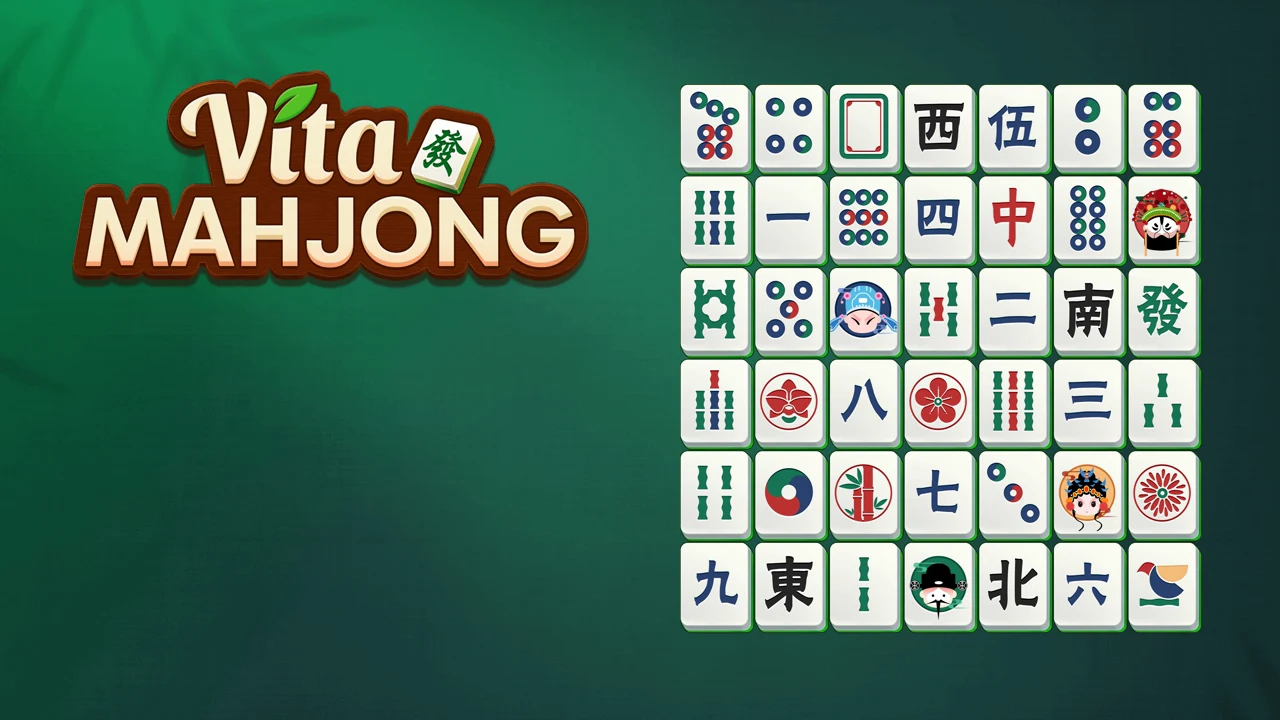
If you searched for how to play Vita Mahjong, this guide is for you. It explains the full game in clear English, from your first move to stronger strategy. You will learn the rules, the flow of a round, and the habits that help you clear more boards with fewer dead ends.
Vita Mahjong looks easy at first, but strong results come from method, not luck. The best part is that the game rewards calm thinking. You do not need fast reflexes. You need to read the board, protect your options, and avoid short-sighted moves.
If you want live practice while reading, open Play Vita Mahjong. Playing and reading together is one of the fastest ways to build real board sense.
What Is Vita Mahjong
Vita Mahjong is a mahjong solitaire puzzle where you clear a layered layout by removing matching pairs of free tiles. A board is complete only when all tiles are gone.
Vita Mahjong uses symbols from traditional mahjong sets, but the rules are different. In classic table mahjong, four players build hands and score combinations. Britannica describes traditional mahjong as a four-player game with 136 to 144 tiles. Vita Mahjong, by contrast, is a solo puzzle built around matching.
This difference matters because the key skill is board management, not hand scoring. Every pair you remove changes the map. A smart match can open several new moves. A careless match can lock useful tiles and create a dead end.
As listed on the App Store and Google Play pages in February 2026, Vita Mahjong is published by Vita Studio. The Google Play listing also shows a very large player base, including 100M+ downloads. That scale does not make the game easier, but it shows why so many people want a clear system for Vita Mahjong.
Core Rule You Must Understand First
Before strategy, lock in the core rule: in Vita Mahjong, you can only match two free tiles with the same face.
A tile is free when:
- No tile sits on top of it.
- At least one long side is open.
This is the standard mahjong solitaire logic described by rule guides such as Mahjong.com. If a tile is blocked on both long sides, it is not free, even when you can see the symbol.
When players say Vita Mahjong feels impossible, they usually broke this rule too often in the opening stage.
How to Play Vita Mahjong Step by Step
Use this sequence every time you start a new board.
- Scan the full layout before your first move.
- Identify high layers and edge clusters.
- Find two or three possible opening pairs.
- Pick the pair that reveals the most hidden tiles.
- Re-scan the board after each match.
Do not rush. Ten seconds of planning can save two minutes of recovery.
Step 1: Read the Layout Shape
Every Vita Mahjong board has a structure. Some layouts are wide and flat. Others are stacked and narrow. Your first job is to find pressure points.
Look for:
- Tall center stacks that hide many tiles.
- Side branches with only one open lane.
- Repeated symbols trapped under top layers.
If you map structure early, Vita Mahjong becomes more predictable.
Step 2: Open, Do Not Just Remove
New players often remove the first visible pair. That feels productive, but it can be a trap. In Vita Mahjong, not all matches are equal.
A strong move opens space. A weak move only reduces tile count.
Choose pairs that:
- Free a blocked side.
- Expose covered tiles.
- Keep duplicate symbols available.
If one pair opens three new choices and another opens none, take the first one.
Step 3: Track High-Risk Symbols
Many Vita Mahjong sets include symbols that appear in multiple copies. If you clear one copy too soon, you may trap the last matching copy under a blocked layer.
Build a simple habit:
- When you see a symbol, quickly locate at least one other copy.
- Avoid using a pair that leaves one isolated tile buried.
This habit prevents a common Vita Mahjong failure: the final single tile with no reachable partner.
Step 4: Work From Top and Outside In
In most layouts, top tiles and edge tiles control access. Clearing them first usually opens the board faster.
A practical order is:
- Top layer blockers.
- Edge blockers with one open side.
- Center tiles that become free afterward.
This order is not a hard law, but it is a reliable default for Vita Mahjong players.
Step 5: Use Tools With Intent
Most versions of Vita Mahjong provide support tools such as hint, undo, and shuffle. Use them like strategy tools, not panic buttons.
- Hint: Use when your scan finds nothing after two full passes.
- Undo: Use to test branches, then compare outcomes.
- Shuffle: Save for true no-move states, not mild confusion.
The puzzle is still your decision game. Tools help you learn faster when used on purpose.
Best Strategy to Win More Vita Mahjong Boards
You now know how to play. Next is how to win consistently. These rules can improve your Vita Mahjong results quickly.
1. Always Keep Multiple Lanes Open
The fastest way to lose in Vita Mahjong is over-committing to one section. If you clear only the left side, the right side may lock itself.
Try to keep at least two active zones. That gives you room when one zone dries up.
2. Prioritize Unblocking Over Pair Count
Removing five easy pairs that open nothing is weaker than removing two pairs that unlock ten tiles. In Vita Mahjong, board access beats short-term volume.
3. Re-check After Every Three Moves
Players miss options because they stay zoomed in. The board changes fast after each match.
Every three moves, pause and do a full scan from top to bottom. This reset catches better lines before mistakes grow.
4. Avoid Creating Lonely Tiles
A lonely tile is a tile whose matching partner is buried or blocked. Too many lonely tiles create forced losses in Vita Mahjong.
Before selecting a pair, ask one question: what happens to the remaining copies of this symbol?
5. Delay Risky Pairs Until You See Consequences
Some matches look safe but close a side lane. If you are unsure, delay that pair and open other parts first. This patient style works well in Vita Mahjong, especially in mid-game.
6. Use Undo for Learning, Not Only Rescue
Strong players use undo as a learning lab. Try branch A, note the new openings, undo, then try branch B. In two minutes you can learn more than random replay.
7. Endgame Requires Extra Discipline
Late-game Vita Mahjong is where many good rounds fail. At this stage, each symbol matters more because fewer partners remain.
In the final 20 percent of tiles:
- Slow down your move speed.
- Check partner locations before each match.
- Protect side openings until the last moment.
Common Mistakes in Vita Mahjong
If you keep losing boards, one of these patterns is likely present.
Mistake 1: Playing Too Fast
Vita Mahjong is not a reaction test. Speed without planning creates blocked lanes. Slow, clear decisions outperform frantic tapping.
Mistake 2: Ignoring Layer Depth
Some tiles look free but hide critical tiles below. If you ignore depth, you may clear the wrong surface and trap key symbols.
Mistake 3: Overusing Hint
Hint is helpful, but constant hint use prevents strategic growth. Your board-reading skill is your long-term edge in Vita Mahjong.
Mistake 4: Saving Undo Until It Is Too Late
Undo is strongest in mid-game, when branches are still flexible. If you wait for disaster, undo has less value.
Mistake 5: Shuffling Too Early
Early shuffle can erase a position you could still solve. In Vita Mahjong, shuffle should be the last option after careful scanning.
A 7-Day Practice Plan for Better Vita Mahjong
If you want real progress, use this short routine. It takes about 15 minutes per day.
Day 1: Rule Accuracy
Play two boards of Vita Mahjong and focus only on free-tile recognition. No speed goals.
Day 2: Opening Quality
Play two boards and write down your first five moves. Check whether those moves opened space.
Day 3: Layer Awareness
During each move, say out loud which layer you are affecting: top, middle, or base.
Day 4: Branch Testing
Use undo intentionally in Vita Mahjong. Test two move branches in the same position and compare which branch unlocks more tiles.
Day 5: Endgame Discipline
Play one board of Vita Mahjong and slow down heavily when the remaining tiles drop below one-third.
Day 6: Low-Tool Challenge
Play with minimal hint use. Only use hint after two complete board scans.
Day 7: Review and Repeat
Play two boards of Vita Mahjong, then note three things: best decision, worst decision, and one rule to carry into next week.
Run this cycle for two weeks and Vita Mahjong will feel less random and more readable.
How to Play Vita Mahjong on Your Website
You asked for a practical workflow, so here it is. Open playvitamahjong.com, choose a board, and apply the same checklist every run:
- Scan shape.
- Open space.
- Protect pairs.
- Re-scan often.
This is a simple system for how to play Vita Mahjong with steady results. Keep a short note after each game. A small feedback loop is enough to improve.
Frequently Asked Questions
Is Vita Mahjong the same as four-player mahjong?
No. Vita Mahjong is a solo matching puzzle. Traditional mahjong is a multiplayer game with draw, discard, and hand scoring.
Is Vita Mahjong mostly luck?
Luck can affect tile exposure, but long-term performance is mostly strategy. Players who preserve options win more often.
When should I use hint in Vita Mahjong?
Use hint after two careful scans and only when you truly cannot see a valid pair. That keeps your decision skill active.
Can beginners get good at Vita Mahjong quickly?
Yes. Most beginners improve in Vita Mahjong within one week when they use consistent rules and slower, cleaner decisions.
Where can I practice Vita Mahjong now?
You can practice Vita Mahjong directly on Play Vita Mahjong. Browser play is convenient for short daily sessions.
Final Takeaway
If you remember one idea from this guide, make it this: in Vita Mahjong, each move should create future freedom. That mindset improves your win rate more than any single trick.
Use the step-by-step system, protect open lanes, and treat each loss as data. With this approach, Vita Mahjong becomes a calm skill game you can improve over time.
If you want to start immediately, play on playvitamahjong.com and run the checklist from this guide on your next board.