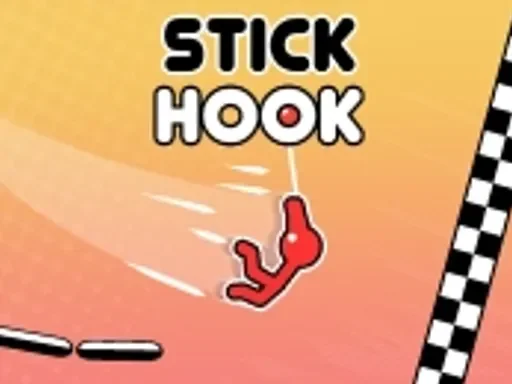
Stick Hook
New Games


The Fast Appeal of Stick Hook
Stick Hook is a physics based arcade platformer built around one action: grab a hook point, swing, and release at the right instant. The rule set is tiny, but the feeling is surprisingly deep because every mistake comes from timing and angle, not from hidden systems. If your release is early, you may lose height. If it is late, you may crash into the next obstacle. That constant cause and effect is what makes the game so replayable.
The loop is short and clean. You enter a level, read the anchor layout, execute two or three precise swings, then try to cross the finish with stable momentum. Runs are brief, restarts are instant, and each retry teaches something useful. Because of that fast feedback, Stick Hook works perfectly for browser sessions where players want quick attempts and clear improvement.
Official store pages identify Madbox as the developer, and listing history places the game launch in 2018. The title has remained active through later updates and has reached a massive audience, including over 100 million installs on Google Play. That long life is easy to understand once you play it: one mechanic, endless timing refinement.
Momentum Is the Real Skill Check
Micro Decisions Inside Every Swing
Each level asks you to make tiny decisions that matter more than they first appear. Do you hold a little longer for height, or release early for forward speed? Do you chain the next hook immediately, or float for a safer entry angle? These choices happen in fractions of a second, and they decide whether your run stays smooth or breaks apart.
Stick Hook does not rely on large menus or progression complexity. It tests your control of trajectory. Once you begin thinking one anchor ahead, you stop reacting and start routing. That shift is where most players level up.
Reading Arc Shape Before You Release
A common pattern is this: releasing near the top of your arc often gives cleaner travel distance, while releasing too low can produce awkward downward speed. Bumper surfaces add another layer because they can redirect momentum in useful ways when approached with the right angle. Advanced runs are not random miracles. They are planned swing entries followed by deliberate exits.
Browser Session Setup on This Site
On this page, Stick Hook loads inside an embedded game frame, so you can play immediately in your browser. Let the frame finish loading, click or tap inside the game area to focus input, and begin. If controls feel delayed, refresh once and reduce heavy background tasks.
Fullscreen mode is usually worth using because it makes hook spacing easier to read. The bigger view helps you predict the next anchor instead of correcting too late. That is especially helpful on longer chains where one poor release can affect several jumps.
Input Model: Press and Release
The control logic is minimal by design. Press, click, or hold to attach. Release to detach and launch. On touch devices the exact same rhythm applies. Since there are almost no extra buttons, your focus stays on timing discipline and path selection.
Performance Habits for Smoother Runs
Use a modern browser version and close extra tabs if your device is struggling. On desktop, a mouse can feel more precise than a trackpad during dense sections. On mobile, short confident taps are often better than long uncertain holds when hooks are close together.
Tactics That Raise Your Clear Rate
Earlier Release on Long Transfers
New players often stay attached too long on big gaps. That can create a steep drop and poor forward carry. Testing slightly earlier releases usually gives a flatter line and a safer landing window.
Calm Recovery Beats Panic Clicking
After a bad jump, repeated panic grabs often make the path worse. A better method is one controlled recovery swing to rebuild rhythm, then a clean push into the next anchor sequence.
Hazard Timing Is Part of Route Planning
Some segments punish impatience more than inaccuracy. Waiting half a beat before a grab can open a safe lane through moving obstacles. Over a full level, consistent timing beats reckless speed.
Use Bumpers as Route Tools
Bumpers are not just chaos generators. With stable approach speed, they become predictable launch tools. Learn where a bounce sends you, then prepare the next hook immediately after impact.
Frequent Run Killers and Fixes
Only Tracking the Character
If your eyes stay on the stickman, your decisions come late. Look slightly ahead and identify the next anchor before your current swing peaks. This one habit improves consistency quickly.
Forcing Maximum Speed Everywhere
Not every section rewards top speed. Some layouts need controlled entry to avoid bad rebounds. Think in terms of useful speed, not absolute speed.
Breaking Your Timing Cadence
The game has a natural rhythm: attach, swing, release, reset. When that cadence breaks, your arcs become inconsistent. Practicing steady timing in easier levels helps you keep control when difficulty increases.
Release Context and Ongoing Popularity
Stick Hook arrived during the late 2010s wave of one mechanic skill games that were easy to start and hard to master. Store records place its initial launch in 2018 under Madbox, and later update history shows the game has been maintained over time rather than abandoned after an early spike.
Its continued reach across app stores and browser portals is mostly design driven. Sessions are short, input is universal, and improvement is measurable. Players can feel progress in minutes, which is rare for games with such minimal controls.
FAQ
Is Stick Hook beginner friendly?
Yes at the start. Controls are simple, but later stages demand better momentum management and cleaner release timing.
Can I play Stick Hook without downloading an app?
Yes. On this site it runs directly in an embedded browser frame, so no separate installation is required.
What are the core controls?
Press or hold to latch onto a hook point, then release to launch forward. The same logic works on mouse and touch.
Why do I keep missing the next hook?
The most common reason is releasing too late. Try releasing a little earlier and plan your next anchor before the current swing ends.
Is the game mostly luck?
Not really. Success is mainly about angle reading, speed control, and repeatable timing rather than random outcomes.
Who developed Stick Hook and when did it launch?
Official store listings name Madbox as the developer, with launch history pointing to 2018 and continued updates in later years.
Comments
Loading comments…